Image of the Day May 21, 2026
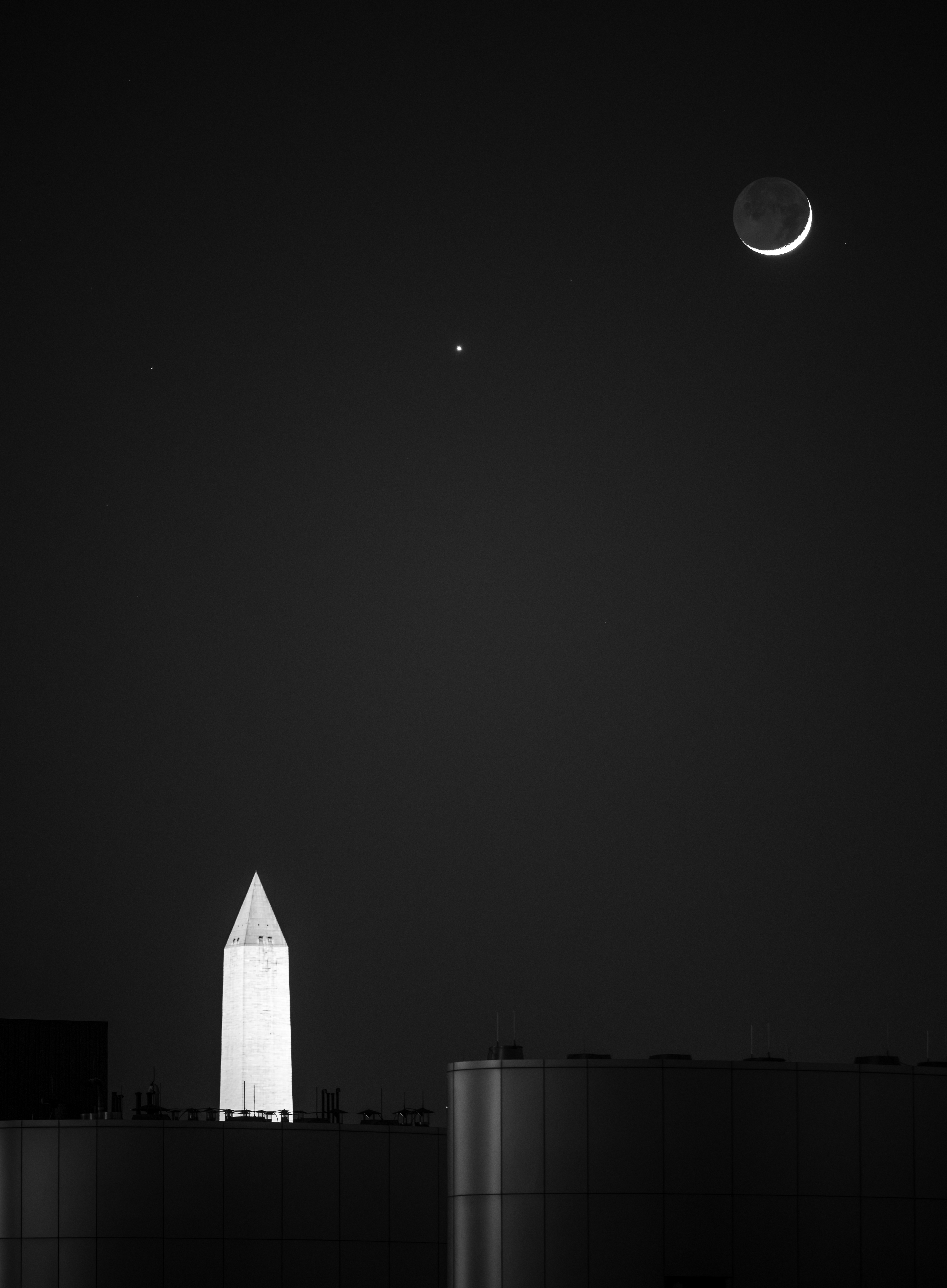
The Moon and Venus over Washington
The Moon and Venus sit in conjunction above the Washington Monument on May 18, as seen from NASA’s Mary W. Jackson Headquarters building. It is a simple image, but a useful one for a daily paper: the sort of alignment that turns orbital mechanics into something visible before breakfast. Venus is bright because its cloud tops reflect sunlight efficiently; the Moon is familiar enough that its presence makes the geometry legible. Nothing rare has to be happening for the sky to become instructive. Sometimes the solar system only needs a monument, a clear line of sight and a photographer paying attention.
Credit · NASA/Bill Ingalls
On This Day 16 years ago
2010
JAXA launches IKAROS, the first solar-sail spacecraft
On May 21, 2010, JAXA launched IKAROS with the Venus Climate Orbiter Akatsuki aboard an H-IIA rocket. IKAROS — the Interplanetary Kite-craft Accelerated by Radiation Of the Sun — was built to prove that a spacecraft could use a large membrane both to gather sunlight for power and to gain propulsion from solar radiation pressure. The idea is old and elegant: trade propellant for patience, and let photons do a small amount of work continuously. IKAROS made solar sailing a flown technology rather than a diagram, helping keep alive a form of propulsion suited to missions where endurance matters more than thrust.
Paper of the Day arXiv · cs.LG
Platonic Representations in the Human Brain: Unsupervised Recovery of Universal Geometry
Pablo Marcos-Manchón, Rishi Jha, Lluís Fuentemilla
This q-bio.NC preprint asks whether the ‘Platonic representation’ idea from machine learning has an analogue in human brains. Using fMRI data from the Natural Scenes Dataset, the authors train subject-specific embeddings from repeated stimulus presentations, then show that independently learned spaces can be aligned across people with unsupervised orthogonal rotations. The claim is not that brains are identical, but that visual-cortex representations may be approximately isometric: different subjects’ neural spaces can be translated through geometry alone. Treat it cautiously as a preprint, but it is a neat bridge between representation learning and neuroscience.
arXiv:2605.20496 →