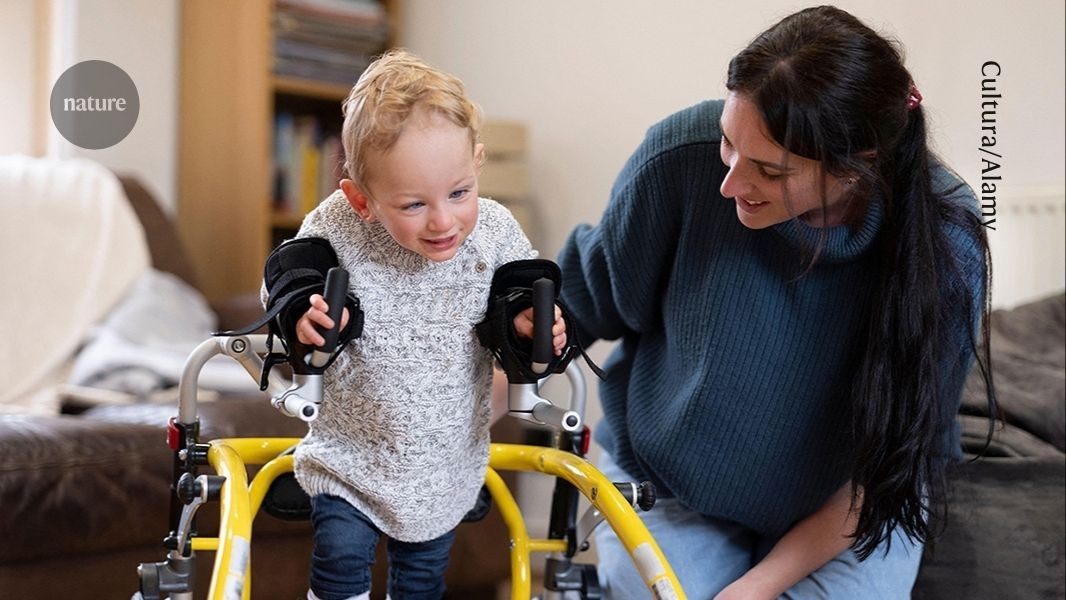
A wearable robot weighing just under one kilogram improved knee function in six children with spinal muscular atrophy, according to research reported by Nature. The children, aged six to ten, had type 2 SMA, could not walk, and were receiving gene therapy. After six weeks using the device, they could stand from a lower sitting angle, had larger quadriceps and generated more than twice as much force when bending their knees.
The study is small, but the clinical question is large. Gene therapies have changed SMA care by slowing or halting motor-neuron loss. They do not automatically rebuild muscles that have already wasted. That leaves a rehabilitation gap: once a child’s disease trajectory has changed, how much function can be restored through intensive, targeted training?
The robot developed by Yanggang Feng, Tony Shu and colleagues attaches at the knee and delivers isokinetic resistance training. In plain terms, it tries to keep leg movement at a constant speed while varying resistance. If the child’s leg moves faster, resistance rises; if movement slows, resistance falls. The system was also gamified, with children seeing themselves kick a ball as they extended the leg.
Nature says the children completed 30 sessions over six weeks, each involving at least 60 leg movements. Before the robot phase, they had taken part in conventional physical rehabilitation without appreciable functional gains. After the robot training, MRI scans showed increased quadriceps cross-sectional area, torque measurements showed stronger knees, electrical recordings suggested improved nerve conduction, and the sit-to-stand starting angle improved from 111 degrees to 104 degrees.
The result is best read as a signal, not a conclusion. Elvira Pirondini, a bioengineer at the University of Pittsburgh, told Nature that the work is clinically important but that it remains uncertain whether the robot itself is uniquely advantageous or whether other forms of high-intensity exercise could produce similar improvements. That distinction matters if the technology is to move from a promising device to a scalable therapy.
Still, the direction is important. The dramatic biotech story in rare neuromuscular disease has been genetic medicine. The quieter next phase will be mechanical, behavioural and rehabilitative: helping bodies recover capacity after the underlying disease process has been slowed. A small wearable robot is not a cure. It is a reminder that successful gene therapy creates new engineering problems worth solving.