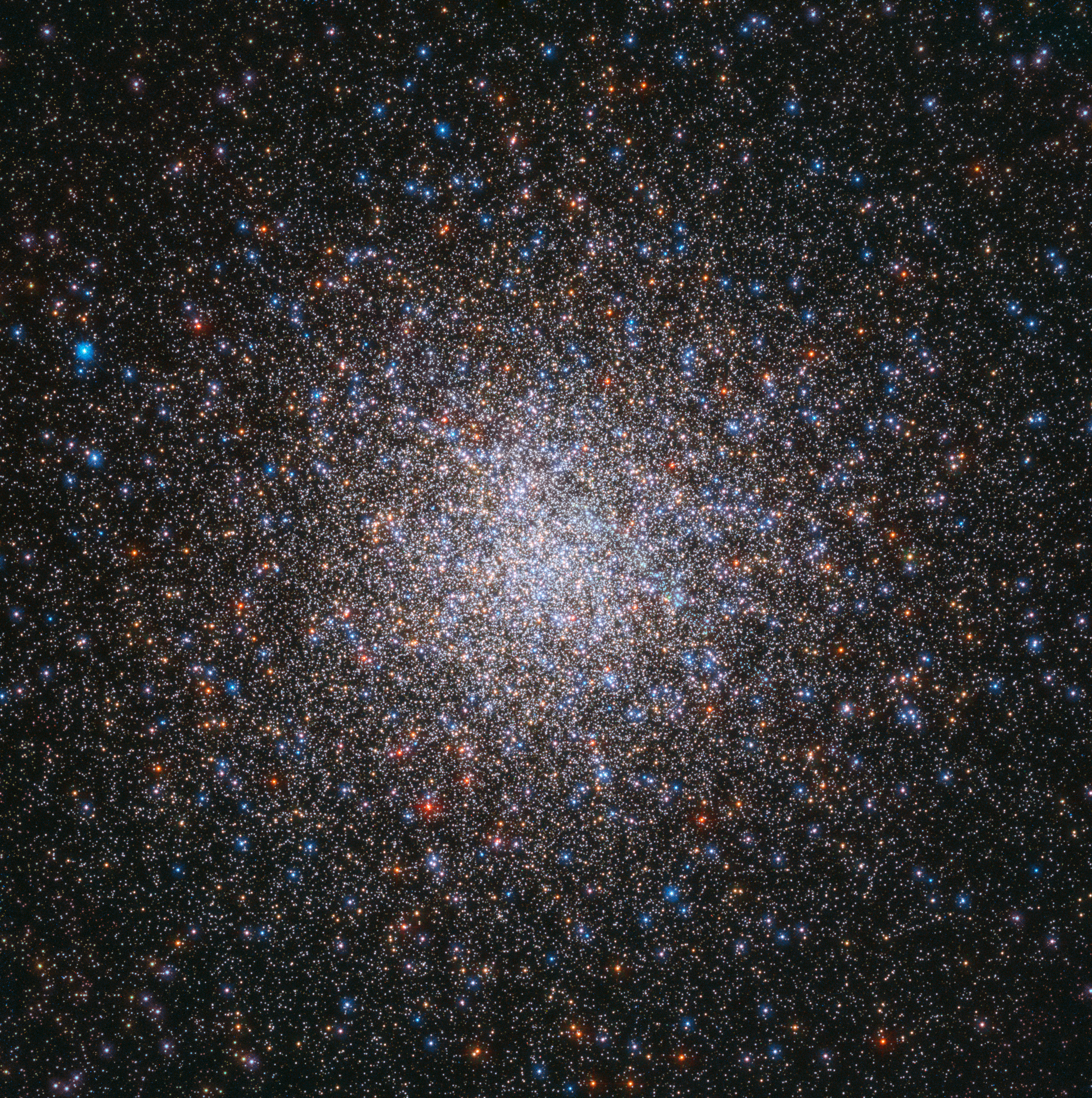
The weekend’s best space picture is not a newly discovered object but a reminder of how strange the old ones remain. NASA’s Astronomy Picture of the Day for May 23 highlights Messier 2, the second entry in Charles Messier’s famous catalogue and one of the great globular star clusters of the Milky Way.
The image, credited to ESA/Hubble & NASA and G. Piotto et al., resolves the cluster’s core into a dense spray of points: blue-white stars, warmer golden stars, and the granular haze of many more packed too closely for the eye to separate. Messier originally described the object as a nebula without stars. Hubble makes that historical mistake easy to forgive. Through an 18th-century telescope, a compact swarm of perhaps hundreds of thousands of suns becomes a fog. Through a modern space telescope, the fog breaks open.
Globular clusters matter because they are old in a way that is difficult to make intuitive. Messier 2 sits roughly 37,000 light-years from Earth in the constellation Aquarius. Its stars formed early in the Milky Way’s life and then remained gravitationally bound, orbiting the galaxy as a compact population. Unlike the Sun’s neighbourhood, where stars are scattered at comfortable distances, a globular cluster is a crowded dynamical system. Stellar encounters are more common; exotic objects such as blue stragglers can appear; and the cluster’s colour and brightness distribution becomes a record of age, chemistry and mass.
That makes an image like this more than decorative. Each pinprick is part of a demographic survey. Astronomers use clusters such as M2 to test models of stellar evolution: how stars exhaust hydrogen, swell into red giants, shed mass, and end as white dwarfs or more compact remnants. The cluster’s ancient population also helps constrain the early assembly history of the Milky Way. It is, in effect, an archive that still shines.
The photograph also has a small historical joke built into it. Messier’s catalogue was compiled partly to help comet hunters avoid confusion. These fuzzy objects looked tempting through small telescopes, but they did not move like comets. The list was a practical nuisance map: not these, look elsewhere. Modern astronomy turned that nuisance map into a greatest-hits collection of nebulae, galaxies and clusters. M2 began as a thing to ignore and became a thing to study.
The image delivers scale without abstraction. Messier 2 looks ornate, but it is not a jewel box. It is a bound city of old suns, dense enough to appear almost solid at the centre, yet separated by distances no human journey can bridge. The image is a study in the mismatch between appearance and physics: delicate points of light marking furnaces, gravity, deep time and motion.
There is a practical scientific reason Hubble images of globular clusters still matter. The telescope can separate stars in crowded fields that blur together from the ground. That separation lets astronomers measure individual brightnesses and colours, build colour-magnitude diagrams, identify unusual stellar populations and compare the cluster to theoretical models. The beauty of the picture is inseparable from the measurement it enables.
For a weekend newspaper, the appeal is simpler: it asks for no breaking-news urgency. It offers the slower pleasure of looking carefully at something that has been in the sky all along, first mistaken for mist, then resolved into history. The news cycle spends the week turning uncertainty into headlines. Messier 2 does the reverse. It takes an old patch of haze and, with enough patience and optics, turns it into evidence.
NASA/APOD’s May 23 selection is therefore a useful palate cleanser after a week of model launches, governance posts and developer-tool updates. It reminds the reader that not every important object is new, and not every image needs novelty to earn attention. Some images are worth publishing because they make the familiar universe newly legible.
Look at the photograph long enough and the centre begins to feel almost noisy. The densest part is a blur of individual histories: stars of slightly different mass and chemistry moving through a shared gravitational potential. Around the edges, the cluster thins into isolated points, as if the city were dissolving into suburbs. That visual gradient is physical information. The crowded core and the looser halo tell astronomers about mass segregation, orbital histories and the long tug-of-war between internal dynamics and the Milky Way’s gravity.
There is also a useful humility in the distance. The light collected in the image has been travelling for tens of thousands of years. It left M2 before recorded human history and reached a telescope above Earth only after passing through an expanding civilisation that did not know the cluster existed for most of that time. The picture is technically precise, but the experience of looking at it is still an old one: a human mind trying to make a small, coherent object out of an enormous sky.
That is why APOD remains valuable even when the image is archival. It keeps a public habit alive: one object, one explanation, one day. In a media environment built for novelty and speed, a daily astronomy image is almost stubbornly pedagogical. It says: here is a thing worth seeing; here is enough context to see it better; come back tomorrow. For Mercury’s weekend edition, M2 earns its place for exactly that reason. It is a slow image for a fast week, and a reminder that patience is still one of astronomy’s instruments.