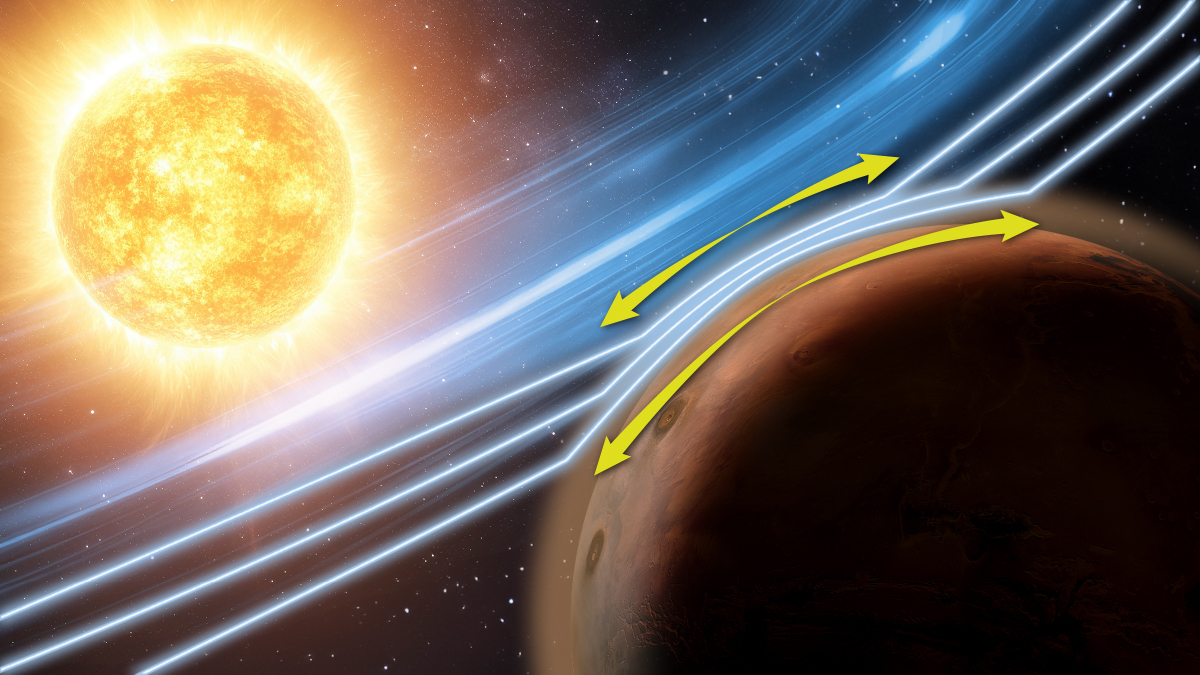
A solar storm at Mars has turned into a physics surprise. Scientists working with data from NASA’s MAVEN mission have identified the Zwan-Wolf effect in the Martian ionosphere, NASA reported on Monday, the first comprehensive observation of the effect in a planetary atmosphere.
The Zwan-Wolf effect has been known since 1976, but until now it had been observed in planetary magnetospheres, not down inside an atmosphere. At Earth, the effect describes charged particles being squeezed along magnetic structures called flux tubes, helping the magnetosphere deflect the solar wind. Mars is different: it has no planet-wide magnetic field like Earth’s. Instead, the solar wind interacts directly with the upper atmosphere and creates an induced magnetosphere whose size and shape can change sharply during solar events.
That is what made the MAVEN detection notable. The team, led by Christopher Fowler of West Virginia University, spotted unusual wiggles in magnetic-field measurements as the spacecraft passed through Mars’ atmosphere. By comparing multiple MAVEN instruments, including measurements of the charged-particle environment, the researchers ruled out other explanations and concluded that a large solar storm had amplified the Zwan-Wolf effect in the ionosphere below 200 kilometres altitude.
NASA’s account is careful not to overclaim. The effect may occur frequently at Mars but normally at levels too weak for MAVEN to detect. The storm acted like a natural experiment, making the plasma motion large enough to catch. The result offers a new way to think about how space weather transfers energy and momentum into an unmagnetized planet’s atmosphere.
The finding has implications beyond Mars. Venus and Titan also lack Earth-style global magnetic shields, so similar processes may shape their upper atmospheres. For Mars specifically, the work adds to the practical problem of forecasting the environment around a planet that hosts orbiters, landers and rovers, and may one day host humans.