Image of the Day May 19, 2026
Vega-C launches Smile
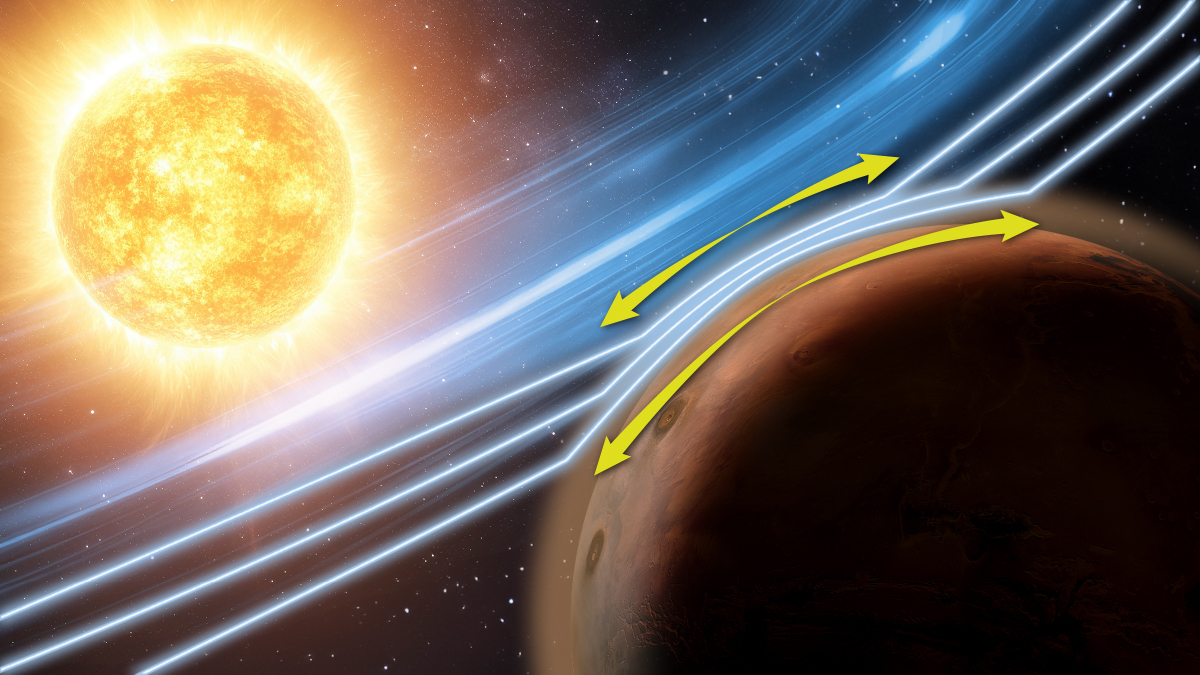
A Vega-C rocket rises from Europe’s Spaceport in French Guiana carrying Smile, the joint ESA and Chinese Academy of Sciences mission to image how Earth’s magnetic shield responds to the solar wind. The photograph works because the story is normally invisible: the magnetopause, magnetosheath and auroral response are not things a camera can simply see from the ground. Smile’s job is to turn that interaction into X-ray and ultraviolet observations, giving space-weather scientists a global view of how the planet’s protective bubble flexes under pressure from the Sun.
Credit · ESA
On This Day 65 years ago
1961
Venera 1 flies by Venus
On 19 May 1961, the Soviet probe Venera 1 became the first human-made object to fly by another planet, passing Venus after a troubled but historic interplanetary cruise. The spacecraft had launched in February as part of the early Venera programme, but contact with Earth was lost before the encounter, so it returned no close-up data from Venus. Even so, the flyby mattered: it proved that a spacecraft could be sent onto an interplanetary trajectory and arrive near another world. Venera 1 belongs to the awkward, failure-rich beginning of planetary exploration, when navigation, communications and thermal control were all being learned in public. Later Venera missions would transform Venus science with atmospheric measurements and the first images from another planet’s surface.
Paper of the Day arXiv · cs.LG
WaveDriver: a Laser Guide Star AO System for HWO
Benjamin L. Gerard, Alex Geringer-Sameth, Aditya R. Sengupta, Alexx Perloff, Dominic F. Sanchez et al.
The proposed Habitable Worlds Observatory will need wavefront stability far beyond JWST’s to directly image Earth-like exoplanets. This paper revisits WaveDriver, a concept that would pair HWO with a laser guide-star spacecraft and onboard adaptive optics. The authors report early work on control methods, including Linear Quadratic Gaussian control and machine-learning approaches, plus sensing, formation-flying and mission-architecture studies. It is an instrumentation paper rather than a discovery paper, but it targets one of the central engineering problems for future exoplanet imaging: keeping a giant space telescope stable enough to see faint planets beside bright stars.
arXiv:2605.18723 →