Image of the Day May 25, 2026
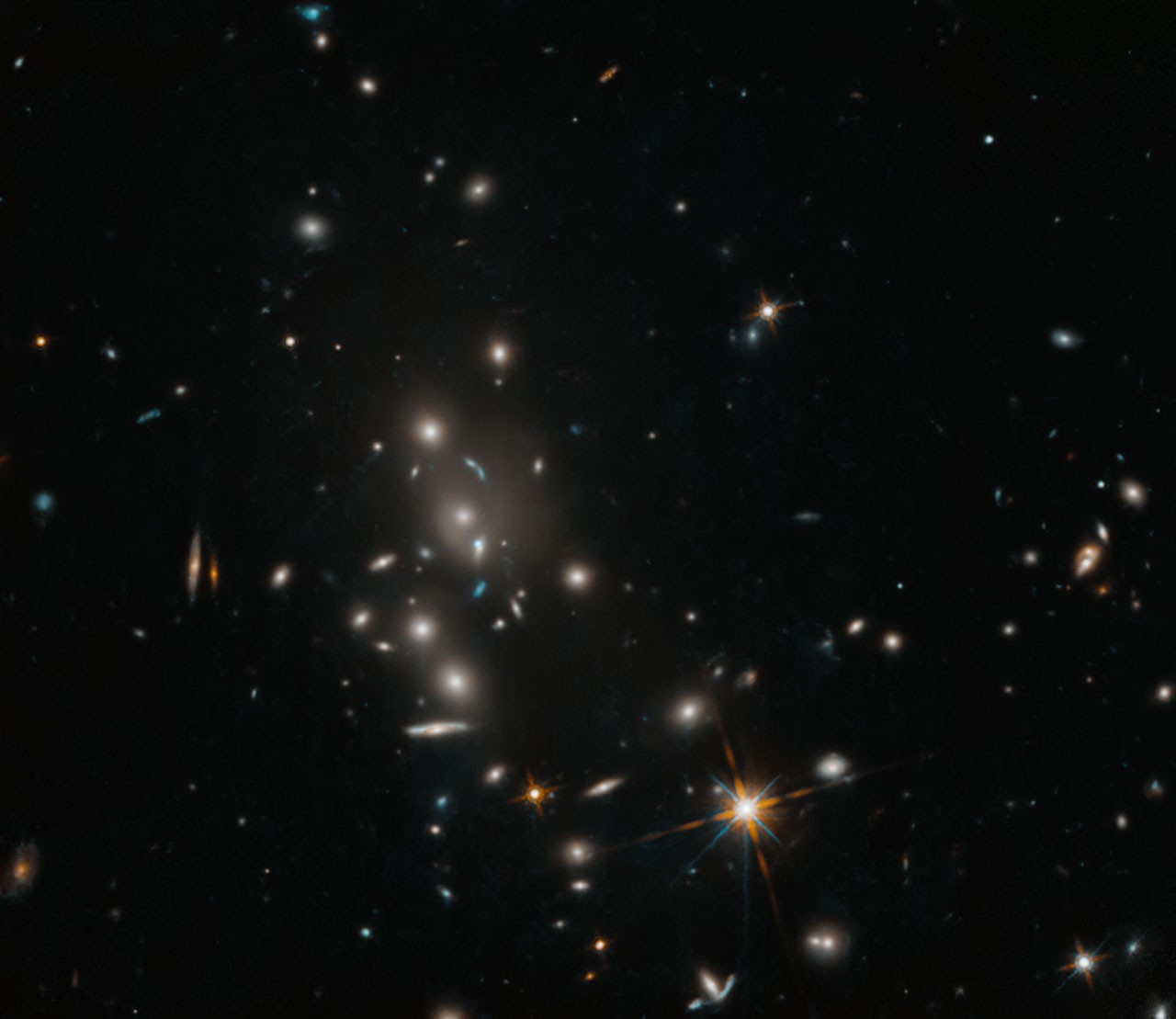
Hubble turns a galaxy cluster into a lens
Hubble’s view of MACS J1141.6-1905 is a useful kind of pretty: the central cluster is also a natural telescope. Its mass bends light from more distant galaxies, a gravitational-lensing effect astronomers use to study objects otherwise too faint or remote to see well. The visible spikes belong to nearer foreground stars and come from diffraction around Hubble’s mirror supports; the crowded centre is the cluster, roughly four billion light-years away in Crater. NASA notes that the image combines visible and infrared Hubble observations from programmes studying bright X-ray clusters and their lensed background galaxies. It is also an archive story: Hubble now holds more than 1.7 million observations, and new tools keep making old photons scientifically useful.
Credit · NASA, ESA, H. Ebeling (University of Hawaii); image processing: G. Kober (NASA/Catholic University of America)
On This Day 18 years ago
2008
Phoenix landed in the Martian arctic
On May 25, 2008, NASA’s Phoenix lander touched down in Green Valley, in Vastitas Borealis, after entering the Martian atmosphere at nearly 13,000 mph. It was the first successful stationary soft-lander on Mars since Viking 2, and Mars Reconnaissance Orbiter’s HiRISE camera caught Phoenix descending under parachute — the first time one spacecraft photographed another during a planetary landing. Phoenix was built to study the Martian arctic: water ice, soil chemistry and whether the environment could preserve clues relevant to habitability. Its robotic arm delivered samples to tiny ovens and wet-chemistry instruments. The mission ended later that year as polar winter cut power, but it helped make Mars’s subsurface ice feel less theoretical and more like a material future missions would have to understand.
Paper of the Day arXiv · cs.LG
New substellar candidates identified through deep learning in the F150 sample of the large-scale SHINE direct imaging survey
Carles Cantero Mitjans, Mariam Sabalbal, Olivier Absil, Marc Van Droogenbroeck, Damien Ségransan et al.
Direct imaging searches for exoplanets and brown dwarfs produce difficult data: the object of interest is faint, close to a bright star, and easily confused with residual optical artefacts. This paper revisits part of the SPHERE High-contrast Imaging survey for Exoplanets using modern deep-learning methods rather than only classical analysis. The aim is to see whether data-driven reprocessing can flag substellar candidates that were missed or left ambiguous in earlier reductions. The result is not ‘AI finds aliens’; it is a practical example of archival leverage. Expensive telescope campaigns may contain more science than the first pipeline extracted, especially as models for image subtraction, candidate ranking and false-positive control improve.
arXiv:2605.23700v1 →