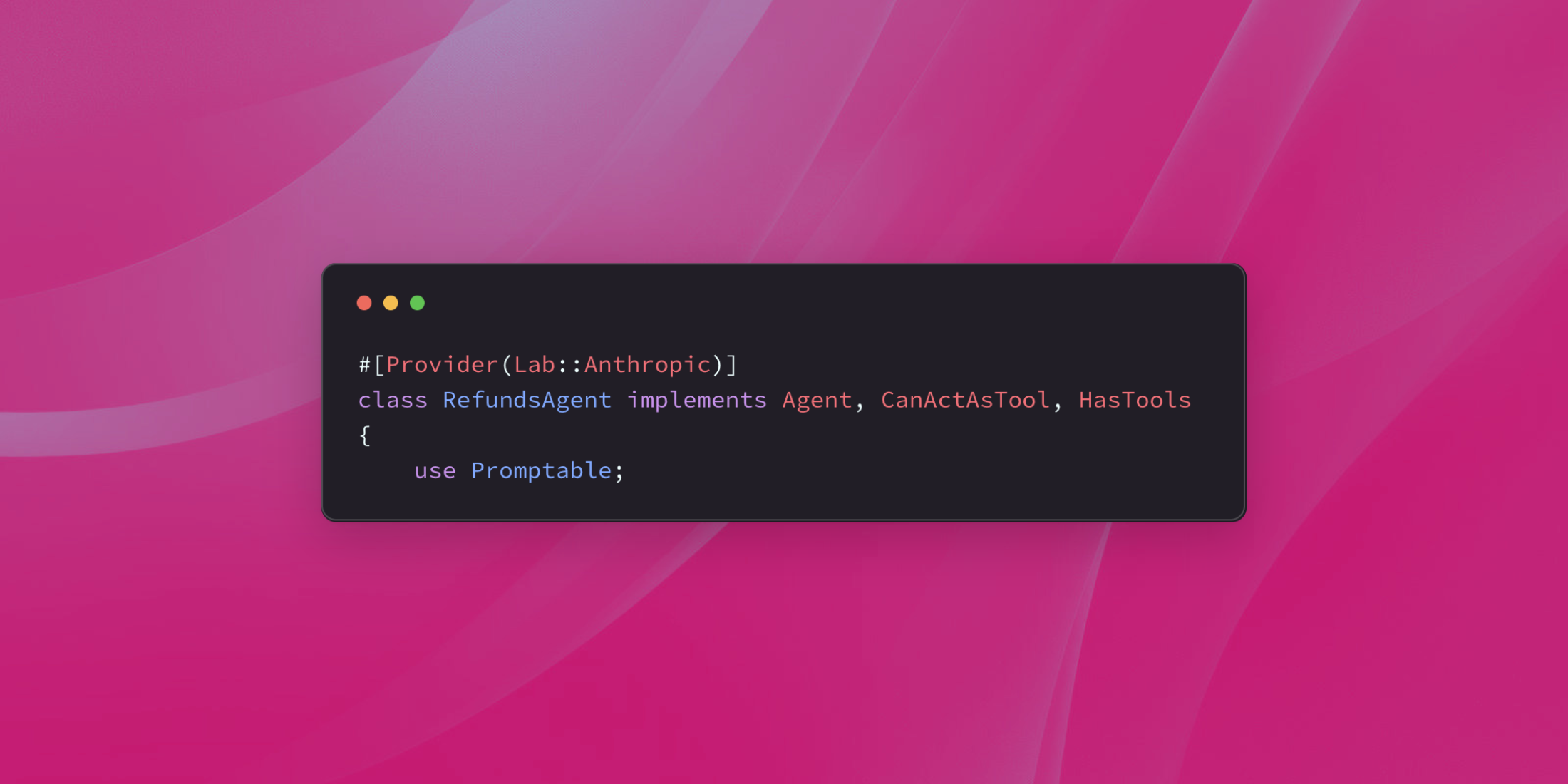
Laravel’s AI SDK now supports sub-agents: a way for one agent to hand a task to another agent and use the result in its own response. In practice, that means a general support agent can delegate a refund query to a refunds agent, a billing query to a billing agent, or a research task to a specialist agent without every capability living inside one oversized prompt.
According to Laravel News, the mechanism is deliberately PHP-native. A parent agent returns another agent from its `tools()` method. The child agent then acts like a callable tool, but carries its own instructions, system prompt, tools, model provider and configuration. A refunds agent might have access to `LookupOrder`; the parent support agent does not need that tool directly. A sub-agent can also use a different provider or model, for example pinning one specialist to Anthropic while the parent runs on OpenAI.
That is a useful pattern for real Laravel applications because most production AI features are not just “ask a model a question”. They require routing, permissions, context boundaries, tool access and failure handling. Splitting a workflow into sub-agents gives teams a cleaner place to express those boundaries. It also reduces the temptation to give one general agent every database lookup, admin action and external API key in the system.
For agencies, the architectural benefit may be stronger than the demo appeal. A client support portal could have separate agents for order history, returns, invoice lookup and policy explanation, each with minimal access to the tools it needs. A back-office copilot could route between CRM enrichment, proposal drafting and internal knowledge search. The important point is that these become application components that can be tested, reviewed and versioned, rather than an expanding prompt blob.
There are still engineering questions to answer before using this in sensitive flows. Teams will need to decide how sub-agent calls are logged, how tool permissions are enforced, how failures are surfaced to users, and whether delegated agents can trigger side effects. The SDK feature gives a structure; it does not remove the need for guardrails.
Even so, this is a notable signal for the Laravel ecosystem. AI support is moving from wrapper code around chat completions toward orchestration patterns that fit normal application design. Sub-agents are not magic. They are a useful abstraction for keeping agentic Laravel code comprehensible.